PART 108 STATUS: as of SEPT. 15, 2026
Final rule in development. Not yet effective.
The FAA published its proposed BVLOS rule in August 2025 and is currently completing the final rulemaking process.
What Does Part 108 Mean for Drone Pilots?
One interesting aspect of the proposed rule is that the FAA did not simply propose creating another traditional pilot certificate comparable to a manned-aircraft certificate.
Instead, the proposal places substantial responsibility on operators to ensure that personnel have the appropriate knowledge, training and skills for the systems and operations they oversee.
The FAA concluded that a single standardized set of pilot knowledge and skills would be difficult to develop for the wide variety of BVLOS aircraft and applications.
This could make operator-specific training and competency programs increasingly important.
The impact of Part 108 will depend largely on what you do with drones.
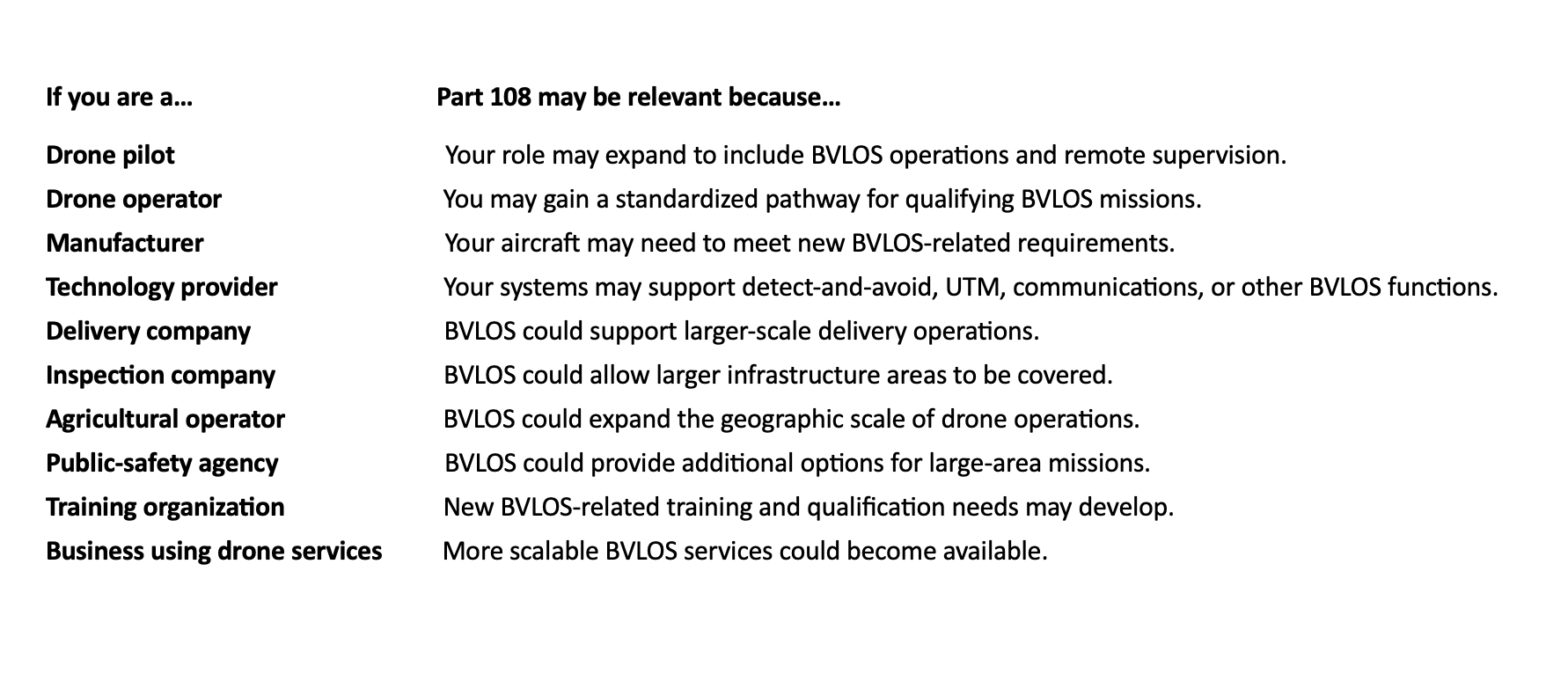
Who Is Affected by Part 108?
Part 108 is designed to create a regulatory framework for routine Beyond Visual Line of Sight (BVLOS) drone operations. Its impact will extend beyond drone pilots to businesses, aircraft manufacturers, technology providers, public agencies, and other organizations that use or support advanced drone operations.
Whether you fly drones, build them, operate a drone business, or rely on drone technology, Part 108 may affect how you plan and conduct operations.
Commercial Drone Operators
Companies that use drones to provide services or collect data
Commercial operators are likely to be among the most directly affected by Part 108.
Potential applications include:
Infrastructure inspection
Utility and pipeline inspection
Mapping and surveying
Construction
Agriculture
Energy
Environmental monitoring
Aerial photography and videography
Large-area data collection
For operators, the key question is how the final rule will establish requirements and authorization pathways for routine BVLOS operations.
What to watch: Operating authorizations, aircraft requirements, operating limitations, detect-and-avoid systems, personnel requirements, and compliance procedures.
Drone Pilots & Remote Operators
People who remotely operate or supervise unmanned aircraft
Part 108 could change what pilots and remote operators need to know and how they perform their jobs.
BVLOS operations can require different skills and procedures than traditional visual-line-of-sight flying, including understanding aircraft systems, communications, airspace, emergency procedures, and operational risk.
The proposed framework places significant responsibility on operators to ensure personnel have the appropriate knowledge, training, and skills for their specific operations.
What to watch: Training requirements, qualification standards, remote-operator responsibilities, and how Part 108 interacts with existing Part 107 requirements.
Drone Manufacturers
Companies designing and building unmanned aircraft
Part 108 could create new opportunities—and new compliance considerations—for manufacturers developing aircraft intended for BVLOS operations.
Aircraft may need to meet specific requirements related to areas such as:
Performance
Reliability
Communications
Detect and avoid
Identification
Aircraft systems
Operational limitations
Airworthiness acceptance
Manufacturers developing aircraft specifically for BVLOS operations will need to understand the final FAA requirements and associated standards.
What to watch: Aircraft acceptance requirements, technical standards, production requirements, and FAA guidance.
Drone Technology & Software Companies
Companies developing the systems that make BVLOS operations possible
Routine BVLOS operations depend on much more than the aircraft itself.
Technology providers may support:
Detect-and-avoid systems
Flight planning
Fleet management
Command-and-control links
Remote aircraft monitoring
UAS Traffic Management
Electronic conspicuity
Identification systems
Operational safety systems
As the regulatory framework develops, these technologies may become increasingly important components of compliant BVLOS operations.
What to watch: Technical standards, performance requirements, interoperability, UTM integration, and FAA-approved or accepted systems.
Drone Delivery Companies
Businesses using drones to transport packages or other goods
Drone delivery is one of the applications specifically contemplated by the FAA's BVLOS rulemaking.
Part 108 could provide a more standardized regulatory pathway for delivery operations that currently require specific FAA authorization.
Potential applications include:
Retail deliveries
Medical deliveries
Food and restaurant delivery
Industrial parts
Warehouse-to-customer delivery
Logistics operations
Delivery operators will still need to meet applicable FAA requirements and obtain the appropriate authorization for their operations.
What to watch: Operating areas, aircraft requirements, population-density limitations, detect-and-avoid capabilities, UTM, and operational authorization.
Infrastructure & Inspection Companies
Organizations using drones to inspect large or difficult-to-access assets
BVLOS can be particularly valuable when an operation covers large geographic areas.
Potential applications include:
Power lines
Pipelines
Railroads
Roads and highways
Bridges
Solar farms
Wind farms
Communications infrastructure
Industrial facilities
Instead of repeatedly repositioning pilots or visual observers, appropriately authorized BVLOS operations could allow aircraft to cover substantially larger areas.
What to watch: Operating-area requirements, aircraft capabilities, remote supervision, communications, and authorization pathways.
Agriculture
Farmers, agricultural service providers, and precision-agriculture companies
Agriculture is another important potential application for BVLOS operations.
Large farms and agricultural operations can cover substantial areas, making BVLOS particularly relevant to:
Crop monitoring
Mapping
Precision agriculture
Imaging
Agricultural spraying
Field inspection
Part 108 would not eliminate other FAA or federal requirements that may apply to agricultural drone operations.
What to watch: Operational limits, aircraft requirements, remote supervision, and how Part 108 interacts with other applicable regulations.
Public Safety & Government Agencies
Law enforcement, fire departments, emergency-management agencies, and other public entities
BVLOS capability could expand the geographic area that public-safety organizations can monitor during emergencies and other missions.
Potential applications include:
Search and rescue
Wildfire response
Disaster assessment
Missing-person searches
Emergency communications
Infrastructure emergencies
Large-area situational awareness
Public-safety organizations would still need to operate under the FAA authorization framework applicable to their specific operation.
What to watch: Public-aircraft operations, Part 107 requirements, COAs, BVLOS authorization, and emergency operations.
Drone Training & Education
Flight schools, training organizations, instructors, and educational programs
Part 108 could create demand for new forms of drone training as BVLOS operations become more common.
Training may increasingly extend beyond basic flight skills to areas such as:
BVLOS procedures
Airspace management
Aircraft systems
Detect and avoid
Communications
Emergency procedures
Operational risk management
Remote supervision
UTM and flight-planning systems
The exact training requirements will depend on the final rule and subsequent FAA guidance.
What to watch: Personnel qualification requirements, operator training programs, recurrent training, and FAA guidance.
Businesses That Use Drone Services
Organizations that don't operate drones themselves but rely on drone data
Part 108 could also affect businesses that hire drone operators rather than owning or operating aircraft themselves.
Potential users include:
Construction companies
Real-estate companies
Insurance companies
Energy companies
Utilities
Agricultural businesses
Engineering firms
Surveying companies
Media companies
As BVLOS operations become more scalable, these organizations may gain access to drone services covering larger areas and more frequent operations.
What to watch: Service availability, operating capabilities, geographic coverage, and the regulatory requirements applicable to service providers.
The Common Thread
Part 108 is fundamentally about making more advanced drone operations possible within a defined regulatory framework.
For some organizations, that could mean new business opportunities. For others, it could mean new technical, operational, or training requirements.
The final FAA rule will determine exactly what changes, when those changes take effect, and which operations qualify.
FlyPart108.com will track those developments as the rule moves from proposal to final regulation.